 Buy now, pay later — powered by PayPal
Bottle protection
How to ship bottles safely: sleeves, boxes & both
Glass bottles break in transit when they can move, knock together or get crushed — so the job of protective bottle packaging is to cushion each bottle and hold it still. This guide from WRAPMEADOW covers the two main approaches — inflatable air-cushion sleeves and double-walled kraft bottle boxes — when to use each, and the single, double, triple and six-bottle options.
How do you ship a bottle without it breaking?
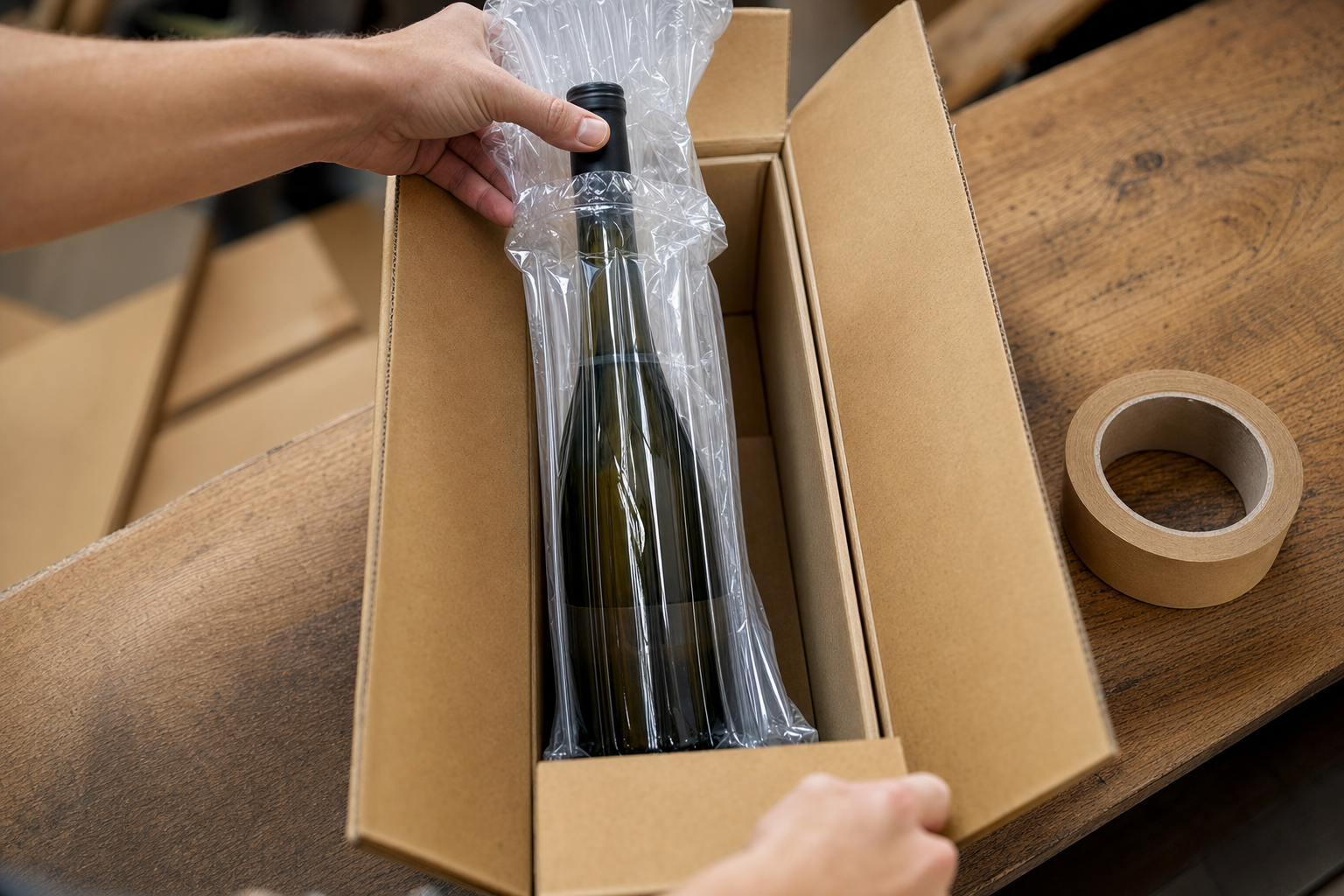
To ship a bottle safely, cushion it on all sides and stop it moving inside a rigid outer box. Bottles crack when glass meets glass or the parcel is crushed, so wrap each bottle in an inflatable air-cushion sleeve — or seat it in a double-walled bottle box with snug dividers — then seal the outer with kraft paper tape so nothing shifts. For more than one bottle, keep each one separated so they can't clink together.
This isn't just our preference — it's what the major UK carriers ask for. Parcelforce Worldwide's published packaging guidelines spell out the box-in-box approach for glass:
"Fragile items e.g. glass, ceramic, stone, plaster etc. must always be suitably packaged to avoid damage from being stacked with other items. Individually package and boxed such items and then place them in a larger box."
— Parcelforce Worldwide, Packaging guidelines
You'll find the same advice in Royal Mail's labels & packaging guidelines: wrap the contents so they can't move and use an outer strong enough for the weight. Parcelforce also notes — and it's worth repeating — that labelling a parcel "fragile" is not a substitute for packing it properly: "Labelling an item as 'fragile' is not a substitute for adequate packaging."
In short: cushion each bottle, separate multiples so they can't touch, and seal everything inside a rigid box.
Inflatable air-cushion sleeve or kraft bottle box?
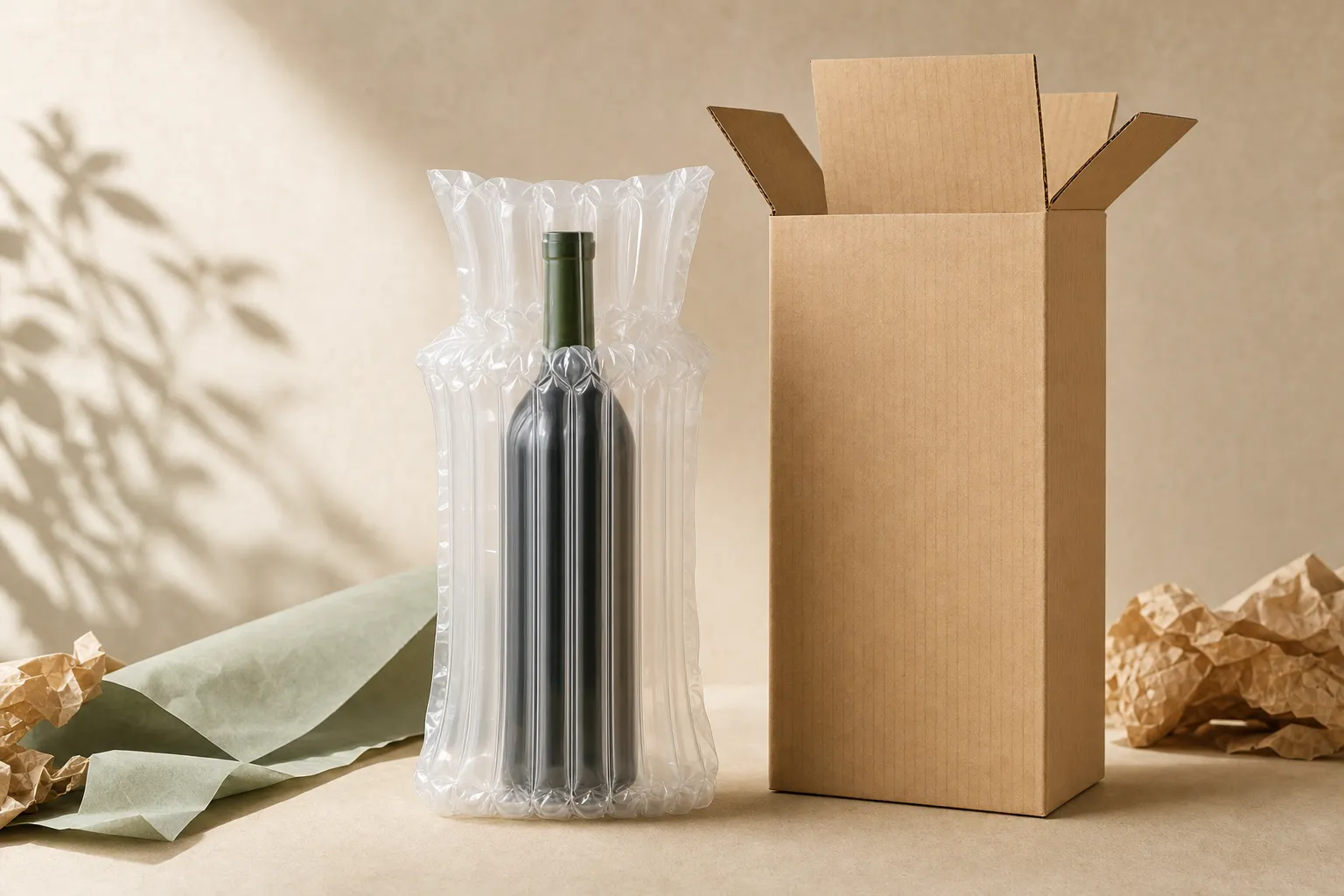
Use an inflatable air-cushion sleeve to wrap and cushion the bottle, and a double-walled kraft bottle box as the rigid shell — many shippers use both together. The sleeve inflates from flat through an easy-inflate valve and surrounds the bottle in air pockets, absorbing shocks the way bubble wrap does but storing flat and weighing almost nothing. The double-walled box gives crush resistance and a clean, stackable courier shape, and presents well as a gift. The sleeves come in two film thicknesses — 65µm for standard use and 100µm for heavier-duty handling.
| Inflatable air-cushion sleeve | Double-walled kraft bottle box | |
|---|---|---|
| Main job | Cushions the bottle on all sides | Rigid crush-resistant outer shell |
| Stores | Flat — inflate when needed | Flat-packed, assemble to use |
| Options | 65µm standard / 100µm heavier-duty | Single, double, triple & six-bottle |
| Best alone for | Hand-delivered gifts | Snug multi-bottle packing |
In short: the sleeve cushions, the box resists crushing — for posting glass, use both together.
Which bottle box do I need — single, double, triple or six?
Choose your bottle box by how many bottles you're sending: single, double, triple or six-bottle. A single-bottle box (with a sleeve inside) is the standard for posting one bottle; double and triple boxes suit small gift sets and mixed cases; and a six-bottle box is the case-quantity option for a full pack. Whatever the count, give each bottle its own cushioned space so they can't knock together.
| Option | Bottle count | Best for |
|---|---|---|
| Air-cushion sleeve | 1 (per sleeve) | Cushioning any bottle, inside a box or for a hand-delivered gift |
| Single-bottle box | 1 | Posting a single bottle safely (use with a sleeve) |
| Double / triple box | 2–3 | Small gift sets and mixed cases |
| Six-bottle box | 6 | Full cases and case-quantity dispatch |
- Single Wine Glass Bottle Inflatable Bags - 65μm Thick — £3.41
- Single Wine Bottle Inflatable Bags, Easy Inflate Valve, 100μm — £4.16
- Double Wine Glass Bottle Inflatable Bags with Easy Inflate Valve - 100μm Thick — £5.55
- Triple Wine Glass Bottle Inflatable Bags with Easy Inflate Valve - 100μm Thick — £6.52
- Wine Bottle Box for 1 Wine / Drink Glass Bottle — £4.27
- Double Layer Packaging Box for 2 Wine / Drink Glass Bottles — £8.98
- Double Layer Packaging Box for 3 Wine / Drink Glass Bottles — £10.15
- Double Layer Packaging Box for 6 Wine / Drink Glass Bottles — £12.40
- 100μm Inflatable Valved Bags & Single Layer Box for 1 Wine / Drink Glass Bottles — £5.45
- 100μm Inflatable Valved Bags & Double Layer Box for 2 Wine / Drink Glass Bottles — £11.22
In short: single box + sleeve for one bottle, double/triple for small sets, six-bottle box for full cases — always cushion each bottle.
When should you use a sleeve, a box, or both?
Use a sleeve alone for hand-delivered gifts, a box alone for snug multi-bottle packing, and both together for anything posted through a courier. A hand-delivered single bottle only needs the cushioning of a sleeve; a snug multi-bottle box with dividers can hold bottles safely for short, careful trips; but a parcel going through the post sees drops and stacking, so it wants the sleeve's cushioning inside the box's crush resistance.
In short: sleeve for hand-delivered, box for snug multi-packs, both together for posting.
We tested it: the 80cm drop check
Specs only tell you so much, so we pack-test the combinations we recommend rather than guessing. On our packing bench we seat a filled 75cl wine bottle inside a valved 100µm air-cushion sleeve, drop it into a double-walled single-bottle box, seal it with 48mm kraft paper tape and drop the parcel flat and corner-first from roughly 80cm — about conveyor-belt height — onto a hard floor. With the sleeve inflated and no void left for the bottle to move, the glass comes through repeat drops intact; the box corner takes the hit and crumples slightly while the bottle stays cushioned and still.
The two failures we see are avoidable: an under-inflated sleeve (leaves the bottle able to shift) and reusing a tired box whose double wall has already been crushed once. Inflate the sleeve firm, use a fresh rigid outer, and fill any remaining void so nothing rattles.
Which protection for how many bottles?
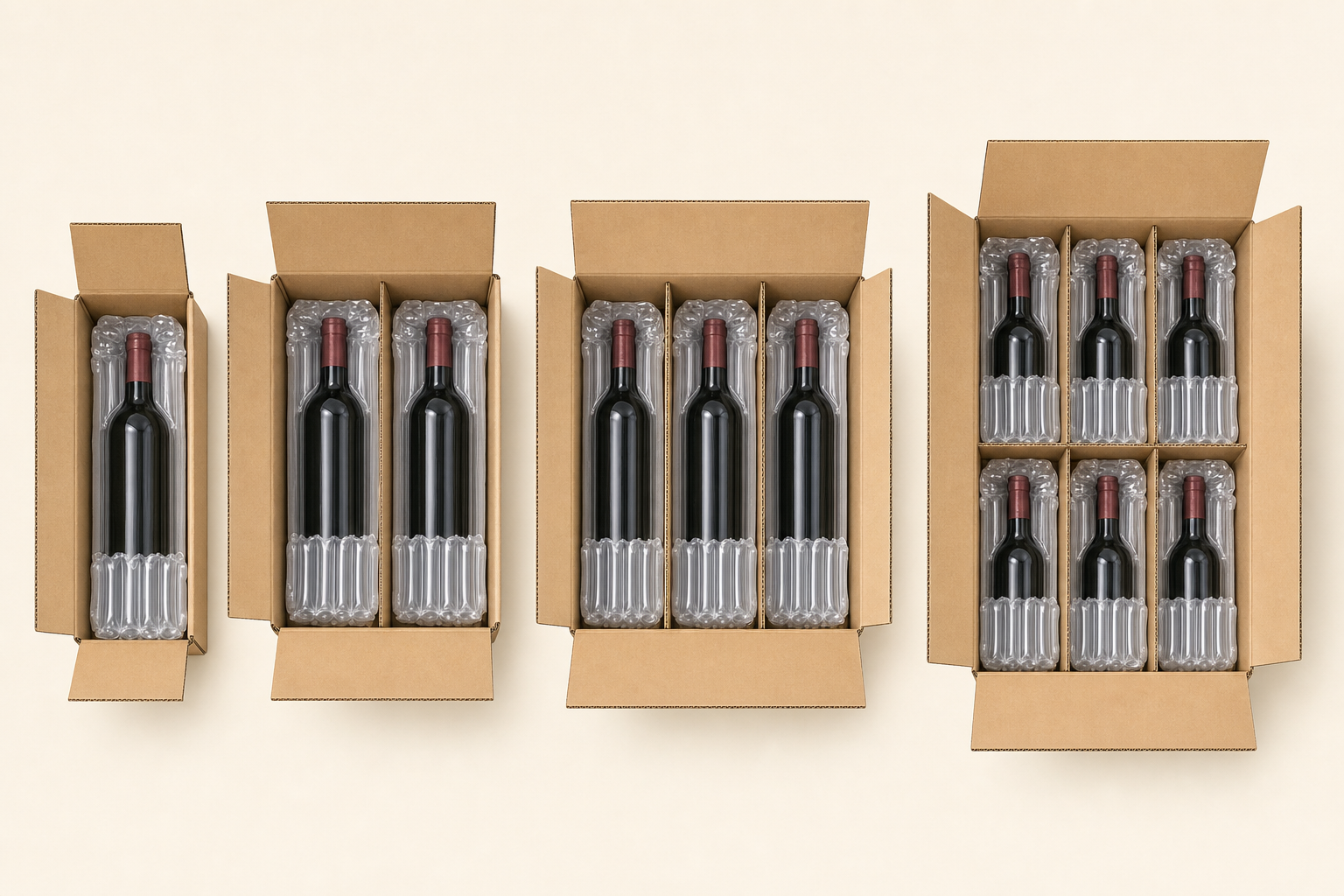
Use this quick fit guide to match the protection to the job — bottle count, the film thickness we reach for, and when each is the right call:
| You're sending | Recommended pack | Sleeve film | Why |
|---|---|---|---|
| 1 bottle (gift, low volume) | Single-bottle box + sleeve | 65µm | Light, low-cost, plenty for occasional single posts |
| 1 bottle (heavy / repeat shipping) | Single-bottle box + sleeve | 100µm | Thicker film stands up to volume handling and heavier bottles |
| 2–3 bottles | Double / triple box, sleeve each bottle | 100µm | Separation stops glass-on-glass knocks in a heavier parcel |
| 6 bottles (full case) | Six-bottle box, sleeve each bottle | 100µm | Case weight and stacking demand the most robust setup |
In short: 65µm is fine for the odd single bottle; step up to 100µm for heavier bottles, multipacks and anyone shipping regularly — and always sleeve every bottle in the box.
Are kraft bottle boxes and paper tape recyclable?
Yes. The double-walled kraft bottle boxes and kraft paper tape are plain paper and board, so they can be recycled together kerbside in most UK areas — there's no plastic strip to peel off the tape first. If you want a recyclability claim on your own outer, the UK's On-Pack Recycling Label (OPRL) scheme is the standard most retailers follow. Larger producers should also check whether they fall under extended producer responsibility (EPR) for packaging, which now requires obligated businesses to report the packaging they place on the market.
In short: kraft box + paper tape recycle together kerbside; use OPRL for labelling and check EPR if you're an obligated producer.
Frequently asked questions
- What's the safest way to post a single bottle of wine?
- Slip the bottle into an inflatable air-cushion sleeve, then seat it in a double-walled single-bottle box and seal the box with paper tape. The sleeve cushions the glass on all sides and the rigid box stops crushing, so the bottle can't knock against anything in transit. For one bottle, the sleeve plus a single-bottle box is the belt-and-braces option couriers prefer.
- What's the difference between 65µm and 100µm air-cushion sleeves?
- The micron figure is the thickness of the sleeve's film: 65µm is the standard-duty sleeve and 100µm is the thicker, heavier-duty version. The thicker 100µm film is more robust for repeat handling, heavier bottles or anyone shipping in volume, while 65µm is fine for most single-bottle gifting and posting.
- Do you need a box as well as an air-cushion sleeve?
- For posting through a courier, yes — use both. The inflatable sleeve cushions impacts, but a rigid double-walled box stops the parcel being crushed and gives the courier a square, stackable shape to handle. For hand-delivered gifts you can use the sleeve on its own, but anything going through the post should have an outer box too.
Shop bottle protection Shop carrier boxes Shop kraft paper tape
Related: how to package a wine bottle for posting in the UK →
choosing wine & beer gift packaging →
Small producer? Buy by the case with no minimum →